

Most people researching residential solar get the same vague answer: sunlight hits panels, electricity comes out. That is technically true, but it leaves out everything that actually matters when you are deciding whether to put a system on your own roof. This guide walks through the real process in plain terms, with context specific to Bermuda that the generic guides skip entirely.

The Whole Process in 60 Seconds
Sunlight is made up of tiny energy particles called photons. When those photons hit the silicon cells inside a solar panel, they knock electrons loose and create an electrical current. That current runs through an inverter, which converts it into the type of electricity your home actually uses. Any extra power either goes into a battery for later or back to the grid.
That is the full loop. The sections below explain what each part means in practice, and why some of those details matter a lot more than people realise before they commit to an installation.
What a Solar Panel Is Made Of
A solar panel is a collection of photovoltaic (PV) cells, usually made from silicon, held together inside a glass-fronted aluminum frame. A typical residential panel contains between 60 and 72 of those cells wired together.
Silicon works because it is a semiconductor. It sits between a conductor like copper and an insulator like rubber in how it handles electrical current. That specific property is what allows the photovoltaic effect to happen at all.
When it comes to choosing panels, most homeowners will be looking at two options:
| Panel Type | Appearance | Efficiency | Best For |
|---|---|---|---|
| Monocrystalline | Uniform dark cells | Higher (20–23%+) | Limited roof space, high heat environments |
| Polycrystalline | Speckled blue look | Slightly lower (16–18%) | Larger roofs, tighter budgets |
Monocrystalline panels consistently outperform in Bermuda's climate. The reason is not just sunlight hours. It is how panels handle sustained heat. Panels that are not rated for island conditions lose meaningful output during the hottest months, which is exactly when you want them performing well.
How Sunlight Becomes Electricity, Step by Step
Here is the full sequence from sunlight hitting your roof to your air conditioning running:
The sun sends out light in the form of photons. When those photons reach the silicon cells in your panel, they transfer their energy directly into the silicon atoms.
That energy knocks electrons loose from their atoms. Because the panel is built with two distinct layers, one positively charged and one negatively charged, the loose electrons move in a consistent direction. That movement is direct current (DC).
Your home runs on alternating current (AC), not DC. The inverter, a box mounted near your main electrical panel, handles that conversion. String inverters manage the whole array at once. Microinverters sit on each individual panel and are often the better choice on Bermuda rooftops with chimneys, parapets, or nearby trees causing partial shading.
The AC electricity feeds directly into your home's electrical system. Your lights, appliances, and air conditioning draw from it exactly the same way they would from the grid. There is nothing different about how they operate.
If your panels are generating more than your home needs at that moment, the surplus flows into a battery system for later use, or back to the BELCO grid if your setup is grid-tied and you are enrolled in their Distributed Generation programme.
What Happens on Cloudy or Windy Days in Bermuda
This comes up in almost every conversation we have with homeowners, and it is a fair question. Bermuda gets real weather, not just clear skies.
Clouds reduce output, but they do not shut it down. Solar panels still generate electricity when it is overcast. Diffuse light still carries photons. On a heavy cloud day you might see 10 to 25 percent of normal output. On a partly cloudy day, 50 to 80 percent is realistic.
Wind has almost no effect on output. What it does do is cool your panels down, which actually helps. Cooler panels run more efficiently. Bermuda's consistent ocean breeze is genuinely an advantage compared to landlocked hot climates where panels bake without relief.
Bermuda averages around 3,000 hours of sunshine per year according to data from the Bermuda Weather Service. That puts the island on par with parts of southern Spain, and well ahead of the UK, Germany, or most of North America. It is a genuinely strong solar environment.
How Your Home Uses That Electricity
Think of your electrical panel as the traffic director. When solar is generating, your home pulls from that first. The grid is the backup, not the primary source.
At night when the panels are not producing, you draw from your battery if you have one, or switch back to the grid automatically. You will not notice the transition.
This is why when you run high-draw appliances matters. Dishwashers, washing machines, and pool pumps running during peak sun hours use free solar electricity instead of paid grid power. It is a simple shift that adds up over time.
Battery Storage: Do You Need It?
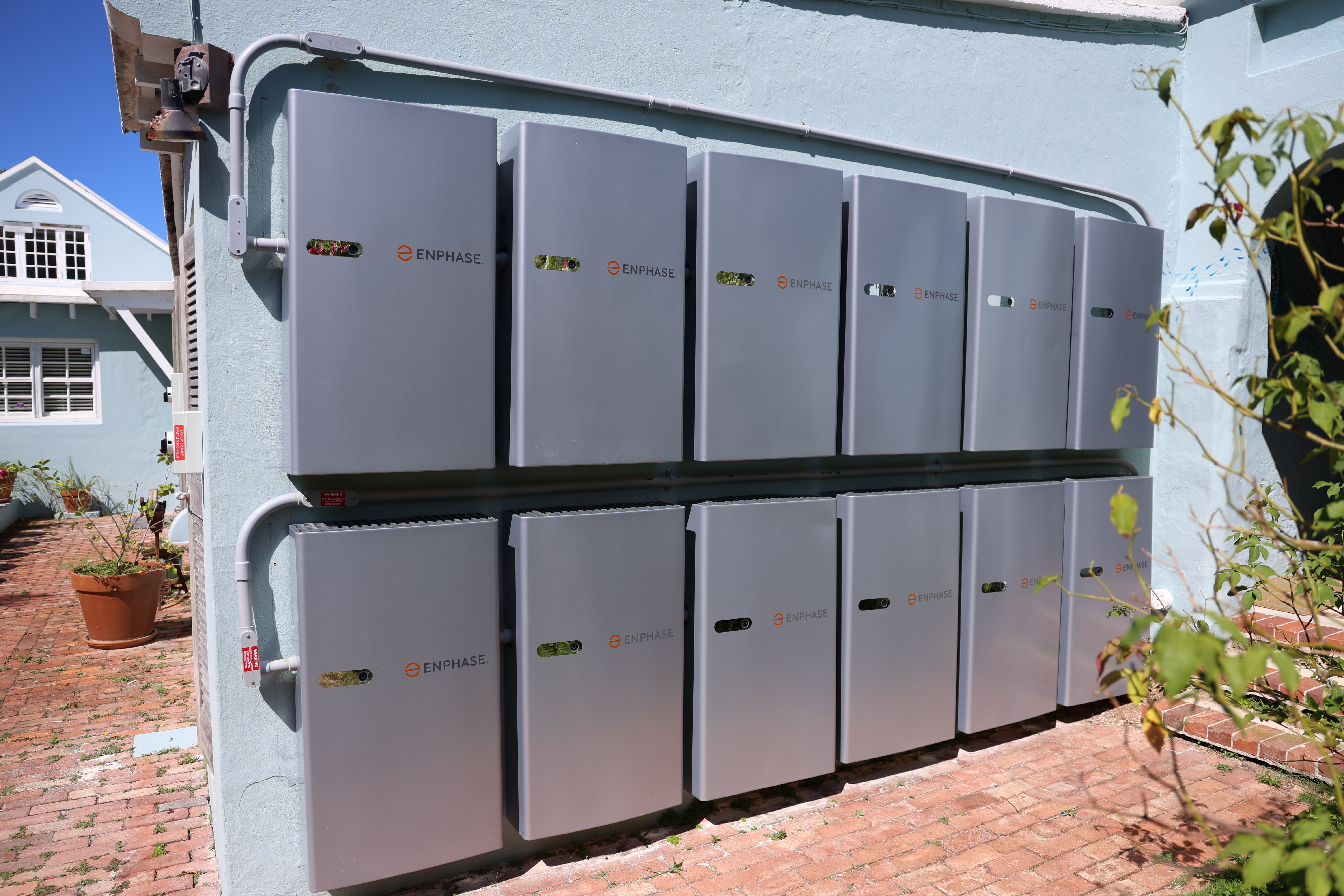
You do not need it to go solar, but for most Bermuda homeowners it makes the system significantly more useful. BELCO rates are high, and outages during storm season are a real consideration, not a theoretical one.
A battery storage system holds onto the surplus your panels generate during the day and releases it at night or during an outage. The most common residential option right now is lithium-iron phosphate (LFP), which handles heat well and holds up over many charge cycles.
Battery storage is not automatically the right call for every home. Whether it makes financial sense depends on your energy usage patterns, how much your roof can generate, and how much backup coverage you actually want. An in-person assessment is the only way to get a straight answer on that.
Why Bermuda Is Actually a Great Place for Solar
The math works better here than in most places. Here is why.
Electricity costs are high
BELCO rates run higher than US and UK averages. Every kilowatt-hour your panels generate is one you are not buying from the grid. That gap is what drives payback timelines, and it works in your favour on this island.
The solar resource is strong year-round
Bermuda does not have a low-sun winter the way northern Europe or Canada does. The sun angle stays favourable all year, which means your system produces meaningful output in every season, not just summer.
Roof size makes panel choice matter more
Bermuda homes tend to have smaller roofs than their North American counterparts. That means you are working with limited space, so getting the most efficient panel available is not a luxury upgrade. It is the practical choice.
Hurricane season is a real factor
Panel mounting needs to meet Bermuda's wind load requirements. This is not something to figure out from a brochure. It requires an installer who knows the local building code and has done this kind of work on island rooftops before.
Things People Get Wrong When Researching Solar
Using output estimates from other countries
Most online solar calculators are built around US or European conditions. Bermuda's climate is different enough that those numbers will not translate accurately. In most cases, actual local output is better than those tools suggest.
Shopping on panel price alone
A cheaper panel installed on a poorly designed system will underperform a quality panel installed correctly. Shading analysis, inverter selection, and mounting angle all affect real-world production more than most people expect before they see it in practice.
Treating battery storage as purely a financial decision
The numbers on battery payback look different depending on how you value outage protection. If you factor in storm season and the peace of mind of running your home independently, the case looks a lot stronger than a pure energy-cost calculation suggests.
Waiting for the next generation of panels
This one comes up often. The honest answer is that today's panels are already excellent, and the incremental gains from waiting are consistently smaller than the savings you leave on the table in the meantime.
Want to know what this looks like for your specific roof?
We have been doing this in Bermuda since 2008. Come out, look at your roof, give you real numbers. No pressure and no guesswork.
Book Your Free In-Home Estimate Serving homeowners across Bermuda · Call or text (441) 505-0803Frequently Asked Questions
Yes, and they work well. Modern monocrystalline panels are built for high-temperature environments. Bermuda's ocean breezes also help keep panels cooler than they would be in a landlocked climate, which supports consistent output through the hottest months.
Most small to mid-size Bermuda homes land somewhere between 10 and 20 panels. The exact number depends on your energy consumption and how much usable roof space you have. A site assessment will give you a specific figure based on your actual household, not a general estimate.
Yes, when installed to Bermuda's wind load requirements. The mounting system matters as much as the panels themselves. Working with a local installer who knows the building code is the key variable here.
No. You can connect a solar system to the grid without battery storage. That said, given BELCO rates and Bermuda's storm season, most homeowners find that adding a battery makes the whole system significantly more useful, not just for savings but for reliability.
Quality panels come with a 25-year performance warranty guaranteeing at least 80 percent of original output at that point. In practice, most systems keep producing well beyond that.
It drops, sometimes significantly. The exact reduction depends on system size, your usage habits, and whether you have battery storage. Homeowners with well-sized systems and batteries often reach near-zero monthly bills.
In most cases, yes. The main things to check are roof condition, the direction it faces, and whether your electrical panel needs updating. A site visit will catch anything that needs addressing before you commit to anything.
It allows grid-tied solar customers to send surplus electricity back to BELCO and receive a credit on their bill. The eligibility details and credit rates can change, so it is worth confirming the current terms directly with BELCO when you are planning your installation.
A string inverter manages all your panels as a single group, so if one panel is shaded, it drags down the whole array. Microinverters sit on each panel individually, so every panel performs on its own. On Bermuda rooftops with chimneys, parapets, or nearby trees, microinverters are often the more practical choice.
The only reliable way to find out is a proper site assessment with a shading analysis. Online irradiance maps give a rough idea, but they do not account for the specific trees, walls, and structures around your property. Our in-home estimate includes this at no cost.