

Ask most people what government support exists for solar in Bermuda and you'll get one vague answer covering three separate things: a rebate program that puts real money back in your pocket, customs duty relief that lowers what you pay at the point of purchase, and a permitting process you have to complete either way, rebate or no rebate. Conflating them leads to bad assumptions, like expecting a rebate check to arrive automatically, or skipping the permit because "solar doesn't need permission." Here's what each one actually involves.
The Solar Energy Technologies Rebate Program: What You Can Actually Get
Bermuda's Solar Energy Technologies Rebate Program, often referred to by its Department of Planning name, the Solar Photovoltaic Rebate Initiative (SPRI), launched on October 11, 2018 and pays a direct rebate based on your property's Annual Rental Value (ARV), the same figure BELCO uses to determine your facilities charge tier.
Up to $8,000 back. Properties with an ARV of $30,000 or less can receive $2 per installed watt of solar PV, up to a maximum of $8,000. Properties between $30,001 and $65,000 ARV can receive $1 per watt up to $4,000, and properties between $65,001 and $120,000 ARV can receive $1 per watt up to $2,000. Properties above $120,000 ARV are not eligible for the PV rebate. Solar thermal (water heating) systems use a separate megajoule-based formula at the same three tiers, up to $2,500, $2,000, or $1,200 respectively.
A few eligibility rules matter as much as the dollar figures. Only one SPRI application is allowed per property assessment number for solar PV, though multiple water heating rebate claims can apply to the same property. You must work through a registered installer. And properties that already had a certificate of occupancy before October 11, 2018 are held to the program's original eligibility terms, worth confirming directly if your property is older.
The rebate isn't automatic. The process runs: choose a participating installer, submit the appropriate planning application, obtain your building permit, complete required inspections during installation, receive your Certificate of Completion and Occupancy from the Department of Planning, then submit your rebate application together with that certificate to the Department of Energy at rerebate@gov.bm.
Customs Duty Relief on Solar Equipment
Separately from the rebate, Bermuda has offered customs duty relief on solar equipment itself. As of the most recent government guidance we could source (an August 2021 government communication), there was no customs duty charged on solar panels, mounting systems, inverters, or other core solar equipment, a meaningful saving given Bermuda's duty rates on most imported goods. Heat pump water heaters carried a preferential 10% duty rate rather than the standard rate, and LED and compact fluorescent lighting carried a 10% rate instead of the standard 25%. For businesses specifically, tariff code CPC 4209 provides end-user duty relief on imported energy efficiency equipment and related building automation systems, requiring an authorization letter from the Department of Energy, typically obtainable within days.
Bermuda's 2025 and 2026 budget-season duty announcements (a July 2025 round of tax and duty reductions, and the February 2026 budget's duty relief on fuel and household goods) didn't specifically revisit solar or renewable energy equipment, for better or worse that likely just means it wasn't part of that particular announcement, not that anything changed. Still, given how much duty rates can shift budget to budget, confirm the current rate directly with Bermuda Customs or the Department of Energy before finalizing a purchase decision based on this figure. One thing this article deliberately does not claim: whether battery storage equipment specifically qualifies for the same duty relief as panels and inverters. The source language references "solar panels, mounting systems, inverters, or other equipment" without naming batteries explicitly, so if battery storage is part of your plan, ask your installer to confirm its current duty classification rather than assuming.
The Permitting Process: What's Actually Required Before You Install
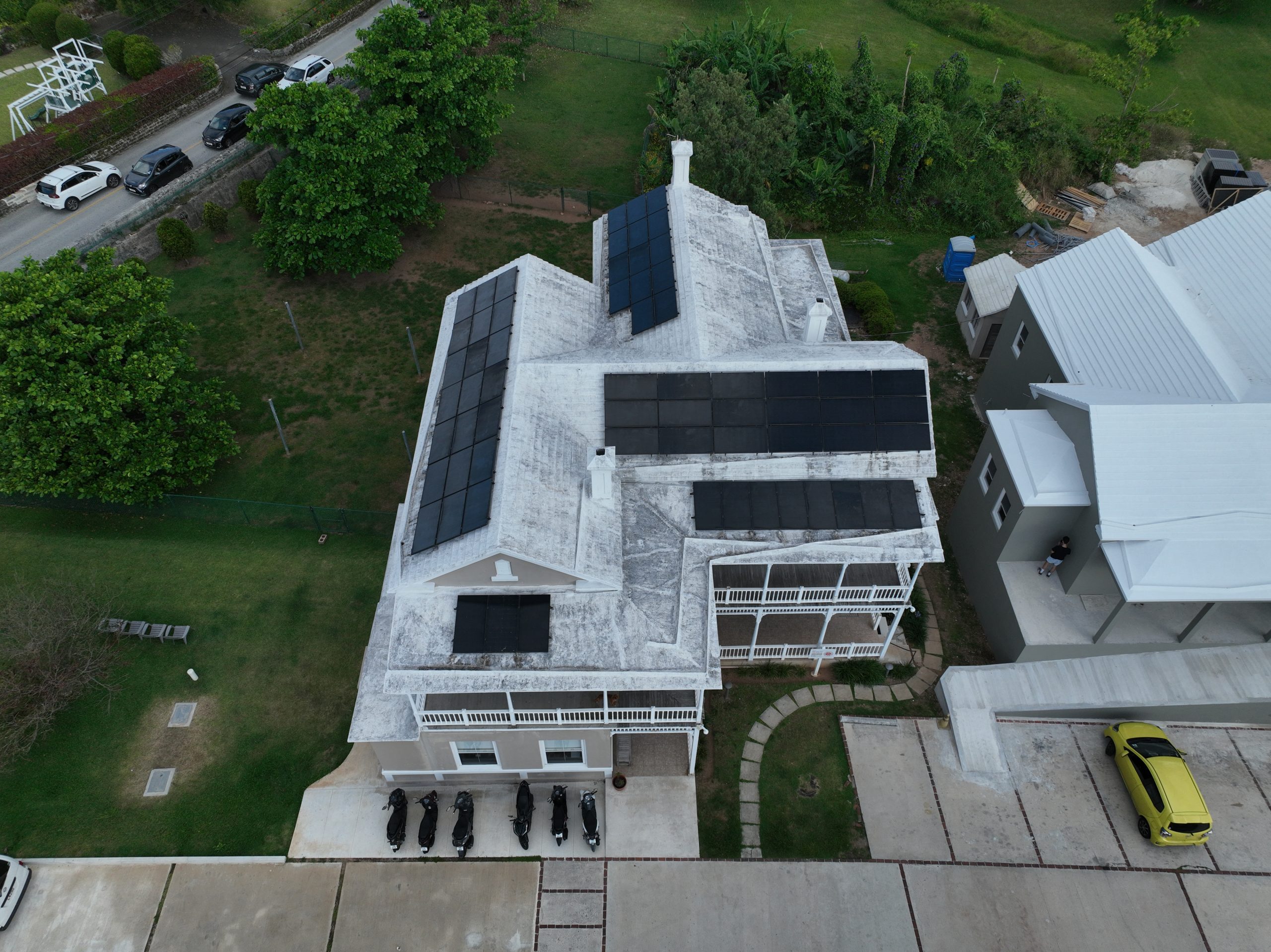
Every solar installation in Bermuda, rebate or no rebate, needs planning approval. Most residential rooftop systems qualify for the Permitted Development Permit (PDP) process, a faster track than full planning review, typically completed in around five working days. Solar energy systems fall under PDP Class V specifically, covering systems up to 1,000 square feet, which covers the overwhelming majority of residential installations.
The PDP process comes with real physical placement rules, not just paperwork. Roof-mounted panels cannot project more than 10 inches from the surface of a pitched roof, or more than 48 inches from the surface of a flat roof, and must maintain at least 4 inches of clearance from roof ridges and edges. Ground-mounted systems are limited to 48 inches in height and cannot be placed within setback areas. And critically for Bermuda specifically, panels cannot impede or prevent the harvesting of rainwater, a direct interaction with the same stepped, whitewashed roof catchment system and Public Health (Water Storage) Regulations covered in our guide to how solar panels work in Bermuda. All proposals still need to satisfy the General Development Order and any applicable local development plan, which is exactly the kind of site-specific detail a proper AES site assessment is built to catch before you're surprised by it mid-application.

Where Government Support Fits Into Your Own Numbers
None of this operates in isolation from the economics we've already covered in our Cost & ROI guide. A rebate reduces your effective upfront cost directly; duty relief lowers what your installer pays for equipment in the first place, which should already be reflected in your quote rather than something to negotiate separately. What's changed the underlying math more than either of these, though, is the direction BELCO's Feed-in Tariff has moved: cut by roughly 42% in October 2023 (from about 22.65 cents to about 13.1 cents per kWh, after regulators found solar generators had been overpaid roughly $254,000 the prior year), and down further to 11.370 cents/kWh under the August 2026 rate restructuring. That decline is exactly why self-consuming your own solar output, rather than exporting it to BELCO, has become worth roughly 4.8 times as much, a figure we break down fully in the Cost & ROI guide. Government rebates and duty relief help with the upfront number; the FIT trend is why what you do with the power you generate matters more than it used to.
AES's Own Track Record With Government Solar Projects
This isn't the first time AES's work has intersected directly with Bermuda's government. In a November 2020 ministerial statement, the Government of Bermuda confirmed it had directly contracted Alternative Energy Systems Ltd. (AES) for a solar installation project spanning four government buildings, the General Post Office, the Government Administration Buildings, the Public Transportation Building, and the Transport Control Department Building.
$2,880,599 contracted, close to $500,000 a year projected in savings. That's the scale of AES's government solar work, confirmed directly by a Government of Bermuda ministerial statement, not a claim we're making about ourselves. It's a useful data point if you're weighing whether a solar installer in Bermuda has experience navigating exactly the same permitting and procurement processes covered in this article, at a scale well beyond a typical residential project.
AES's track record isn't limited to government contracts either. The same site-assessment, permitting, and installation process described throughout this article applies whether the customer is a government department or a local business.
Common Myths and Mistakes
- "The rebate arrives automatically once my system is installed." It requires a specific application to the Department of Energy after receiving your Certificate of Completion and Occupancy, it's not triggered automatically by installation.
- "I don't need a permit if I'm just doing a small residential system." Nearly all residential solar falls under the Permitted Development Permit process specifically because it's faster, not because it's optional; a permit is still required.
- "Duty relief and the rebate are the same program." They're separate: duty relief lowers what your installer pays for equipment (reflected in your quote), while the rebate is a direct payment you apply for after installation, sourced from the Department of Energy, not Customs.
- "My battery storage is covered by the same duty relief as my panels." The clearest source we found doesn't explicitly confirm this; ask your installer to check current classification rather than assuming it.
- "The rebate program has unlimited funding, so there's no rush." It explicitly runs first-come, first-served with limited available funds; confirm current availability before counting on it in your budget.
Bermuda offers three separate forms of government involvement in a residential solar project: the Solar Energy Technologies Rebate Program (SPRI), a direct rebate of up to $8,000 for solar PV depending on your property's ARV, applied for after installation; customs duty relief on core solar equipment, which should already show up in your installer's quote rather than something you apply for separately; and a permitting process, typically the faster Permitted Development Permit track for residential systems, which every installation needs regardless of rebate eligibility. Layered on top of all three is a declining Feed-in Tariff that makes self-consumption more valuable than it used to be. None of these figures should be taken as guaranteed without a direct, current confirmation, government programs and duty rates can and do change, which is exactly why a real AES site assessment includes walking through what currently applies to your specific property.
Frequently Asked Questions
What government rebates are available for solar panels in Bermuda?
The Solar Energy Technologies Rebate Program (SPRI) offers a direct rebate based on your property's Annual Rental Value, up to $8,000 for solar PV systems on properties with an ARV of $30,000 or less, with lower amounts at higher ARV tiers.
How much can I get back through the Solar Energy Technologies Rebate Program?
Up to $8,000 for PV (ARV $30,000 or less), up to $4,000 (ARV $30,001-$65,000), or up to $2,000 (ARV $65,001-$120,000), calculated at $2 or $1 per installed watt depending on tier. Properties above $120,000 ARV are not currently eligible for the PV rebate.
Is there customs duty on solar panels and equipment in Bermuda?
As of the most recent guidance we sourced (2021), there was no customs duty on solar panels, mounting systems, or inverters, with preferential rates on heat pump water heaters and efficient lighting. Confirm the current rate with Customs or the Department of Energy before finalizing a purchase, since duty policy can change.
Do I need a permit to install solar panels in Bermuda?
Yes. Nearly all residential solar systems go through the Permitted Development Permit process, a faster approval track than full planning review, but a permit is still required regardless of system size or rebate eligibility.
How long does solar permitting take in Bermuda?
Systems that qualify for the Permitted Development Permit (most residential systems up to 1,000 square feet) typically take around five working days to process, faster than a full planning application.
What are the placement rules for roof-mounted solar panels in Bermuda?
Roof-mounted panels can't project more than 10 inches from a pitched roof or 48 inches from a flat roof, must keep 4 inches of clearance from roof ridges and edges, and can't impede rainwater harvesting from the roof.
Can I install ground-mounted solar panels in Bermuda?
Yes, subject to rules: ground-mounted systems are limited to 48 inches in height and cannot be placed within required setback areas.
Is the Feed-in Tariff a rebate or incentive?
No, it's separate. The Feed-in Tariff is what BELCO pays you for solar power you export to the grid, currently 11.370 cents/kWh as of the August 2026 rate structure, down significantly from rates before October 2023. It's ongoing compensation for exported power, not a one-time rebate or duty benefit.
Does government support cover battery storage too?
This isn't clearly confirmed in the sources we found; the duty relief language references panels, mounting systems, and inverters without explicitly naming batteries. Ask your installer to confirm current duty classification for battery storage specifically.
Is the SPRI rebate program still accepting applications?
We could not confirm current fund availability from published sources; the program explicitly operates first-come, first-served with limited funds. Confirm directly with the Department of Energy (rerebate@gov.bm) before counting on a rebate in your budget.