

Bermuda's grid goes down more often than most people plan for, not just during a named hurricane. In the twelve months leading into this article, BELCO customers weathered at least three separate multi-thousand-customer outages: Hurricane Imelda, Hurricane Melissa, and a winter gale-force storm in early February 2026 that had nothing to do with hurricane season at all. A solar battery doesn't just store sunshine for savings. It changes what happens in your home or office the next time the power goes out, and it does it in a few specific, concrete ways worth understanding before you decide whether one is worth adding to your system.
Keeps Essential Power Running During BELCO Outages
Bermuda's outages aren't rare, isolated events. Hurricane Imelda knocked out power to roughly 18,000 BELCO customers on October 1 and 2, 2025, with over 11,600 still in the dark by noon the following day. A month later, Hurricane Melissa took out power to around 19,000 customers, though BELCO crews had roughly 17,200 of them back on by that same evening. Then, well outside hurricane season, a gale-force winter storm on January 31 and February 1, 2026 knocked out power to close to 3,000 customers island-wide, driven by wind-blown vegetation and one memorably airborne trampoline tangled in a line near St. David's.
Three separate storms, roughly four months, tens of thousands of affected BELCO customers each time, and only one of them was a named hurricane.
A solar battery with backup capability keeps drawing on stored charge the moment the grid drops, without you doing anything. What stays running depends on how the system is sized and wired, a battery paired with a load controller can keep specific circuits (fridge, Wi-Fi, a few outlets) alive for longer, or a larger system can cover more of the home, but the basic function is the same: your home isn't simply dark and silent the moment BELCO's line goes down.
Charges Itself Ahead of the Storm, Automatically
The most useful protection often happens before the outage, not during it. Enphase, whose IQ Batteries AES installs, builds a Storm Guard feature into its system that watches weather forecasts and automatically charges the battery to full ahead of severe weather, so it's not caught at a partial charge when the grid actually goes down. For Bermuda specifically, where a storm can turn from a forecast into an outage within a day, that automatic timing matters more than it would somewhere with longer warning windows.
This is also where the Enphase app becomes genuinely useful rather than a nice-to-have: it shows real-time production, usage, and battery charge, and it lets you turn power-hungry appliances on or off remotely to stretch your stored charge further if an outage runs long, all from a phone, which matters if you're not physically at the property when a storm hits.
A Safer Backup Than a Fuel Generator
Fuel generators are the default backup power option for a lot of Bermuda properties, and they work, but they come with real tradeoffs a battery doesn't. A generator needs stored fuel on-site, which is its own hazard during a storm (spill risk, fire risk, and simply finding fuel when the whole island is preparing at once). It needs to be started and refueled manually, sometimes in the middle of the storm that knocked your power out in the first place. And it runs on combustion, which means exhaust fumes and carbon monoxide risk if it's not vented properly, a real concern for anyone tempted to run one too close to a door or window during heavy rain.
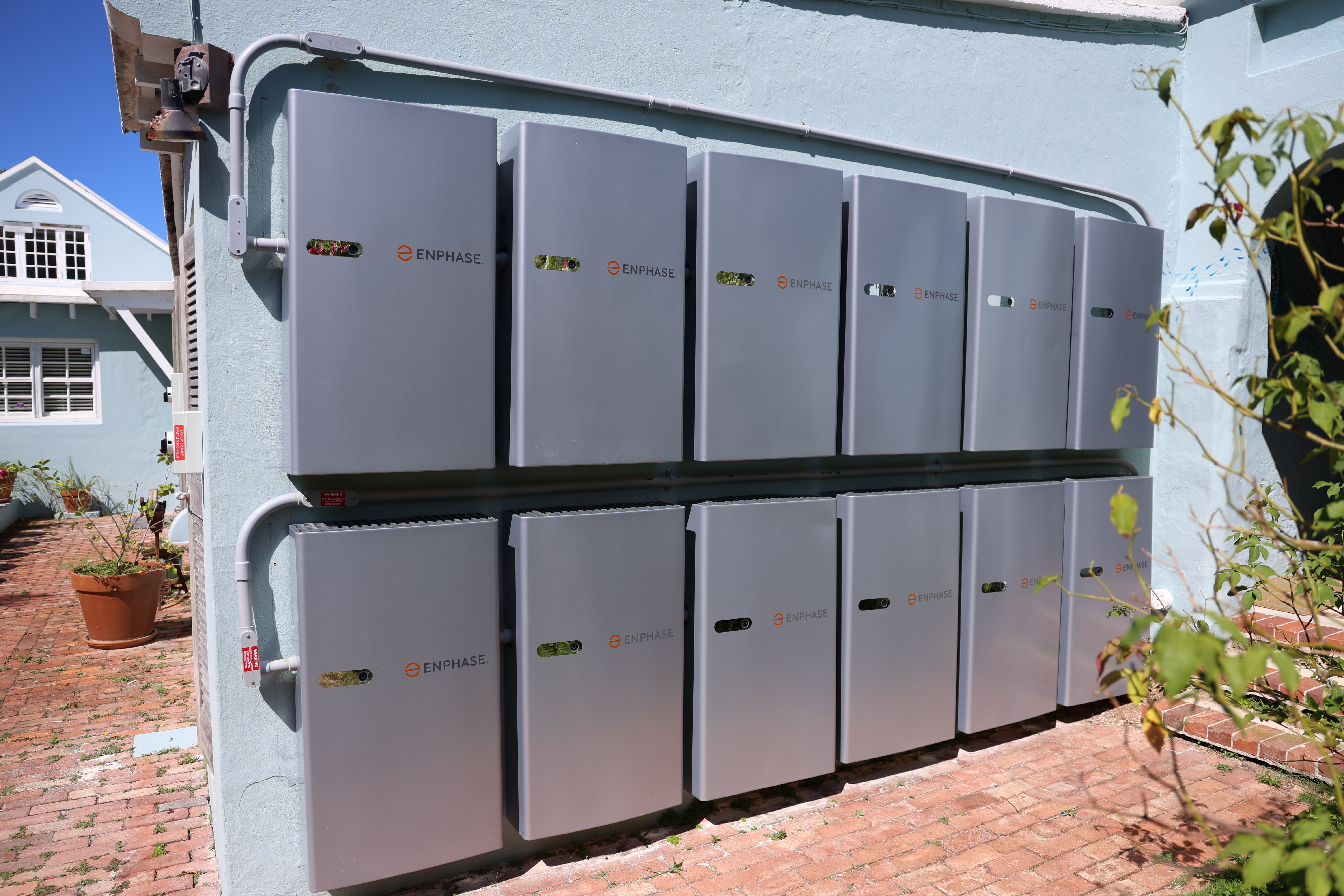
A battery system has none of that. AES's Enphase IQ batteries run on low-voltage DC power specifically to avoid the hazards of high-voltage DC systems, and they're NEMA 3R rated for outdoor, harsh-weather installation, built for exactly the salt air and storm exposure Bermuda properties deal with. No fuel to store, no fumes, no manual start in the middle of a storm.
Keeps Small Business Operations Running, Not Just the Lights
The "office" half of this matters as much as the "home" half. A power outage doesn't just mean inconvenience for a small Bermuda business, it can mean a point-of-sale system that can't process a sale, a walk-in fridge full of inventory warming up, a server or Wi-Fi router that takes a whole workday offline, or a security system that goes dark exactly when it's needed most.
The same battery backup mechanics from Way 1 apply directly to a small office or retail space: critical circuits stay powered through an outage that would otherwise mean lost sales, spoiled stock, or a day of downtime. For a business where even a few hours without power has a real dollar cost, that's not a convenience feature, it's risk management, and it's worth sizing a system around business-critical loads specifically rather than assuming a residential-style setup automatically covers it. That's exactly the kind of detail an AES site assessment is built to catch, alongside the roof and usage factors covered in our guide to how solar panels work in Bermuda.
Protects Your Wallet Under the New BELCO Rate Structure Too
Protection isn't only about outages. BELCO's August 2026 rate restructuring introduced a new flat Distributed Generation facilities charge for solar households and reshaped how much a kilowatt-hour is actually worth to avoid buying, covered in full in our BELCO rate change breakdown. A battery is one of the more direct ways to capture value under that new structure: instead of exporting solar power back to the grid at BELCO's Feed-in Tariff rate, a battery lets you store it and use it yourself later, during the exact tail-block hours when BELCO electricity is priced highest.
Consuming your own solar output is worth roughly 4.8 times exporting it back to BELCO.
We've broken down the full math, including a worked example, in our solar cost and ROI guide. Put together, that means a battery is protecting two different things at once: your operations during an outage, and your bill under the current rate structure, which is part of why it's worth evaluating as a real line item rather than an optional extra when you're planning a system.
Common Myths and Mistakes
- "A generator is simpler, so it's the better choice." Simpler to buy, not necessarily simpler to use safely in a real storm, when fuel, fumes, and manual startup all become harder, not easier.
- "A battery only matters if I lose power a lot." Bermuda had three separate multi-thousand-customer outages across roughly four months covered in this article alone, hurricane season and winter storms both count.
- "Any battery will keep my whole house running for days." Backup duration depends on the battery's capacity and what you're running, not a fixed guarantee, which is exactly why sizing it against your actual critical loads matters.
- "Batteries are only for homes, not businesses." The same backup mechanics protect a small office or retail space, often with a more direct dollar cost to losing power than a home has.
- "A battery is just for storm backup." The August 2026 BELCO rate changes made the everyday self-consumption value of a battery just as relevant as its emergency-backup value.
Frequently Asked Questions
Does a solar battery keep my power on during a BELCO outage?
Yes, a battery with backup capability keeps drawing on stored charge automatically the moment the grid drops. What stays powered and for how long depends on the battery's capacity and how the system is wired to your critical circuits.
How is a solar battery different from a generator for backup power?
A battery has no fuel to store, no fumes or carbon monoxide risk, and no manual startup required during the storm. AES's Enphase IQ batteries also use low-voltage DC power and are NEMA 3R rated for harsh outdoor weather.
Can a solar battery protect a small business or office in Bermuda, not just a home?
Yes. The same backup mechanics that keep a home's essential circuits running apply to a small office or retail space, protecting point-of-sale systems, refrigeration, servers, Wi-Fi, and security systems during an outage.
Does the battery charge itself before a storm?
Enphase's Storm Guard feature, built into the IQ Batteries AES installs, monitors weather forecasts and automatically charges the battery to full ahead of severe weather, so it's not caught at a partial charge when an outage hits.
How long can a solar battery power my home during an outage?
It depends on your battery's capacity and what you're running, a few essential circuits will last longer than trying to power a whole home. AES sizes this against your actual usage during a site assessment rather than quoting a fixed number.
Is a solar battery safe to use indoors or near living spaces?
AES's Enphase IQ batteries operate on low-voltage DC power specifically to avoid the hazards associated with high-voltage DC systems, and are NEMA 3R rated for harsh weather performance.
Does a solar battery help with BELCO's new facilities charge?
Indirectly, yes. It doesn't change the facilities charge itself, but it lets you self-consume more of your solar output instead of exporting it at BELCO's lower Feed-in Tariff rate, which is where the real financial value shows up, covered in our solar cost and ROI guide.
What happens if my battery runs out of charge during a long outage?
The Enphase app lets you monitor charge in real time and turn off power-hungry appliances remotely to stretch remaining charge further, useful for extending coverage through a longer outage.
Do I need solar panels to add a battery, or can I add a battery to an existing system?
A battery is typically added alongside an existing or new solar panel system rather than standalone, since it's charged primarily by your own solar production. AES can assess what fits your existing setup.
How do I know if a solar battery is worth it for my home or office?
It depends on your usage pattern, how much outage protection matters to you, and how much of your solar output you currently export versus use. AES models this against your real numbers during a free in-home estimate rather than a generic rule of thumb.